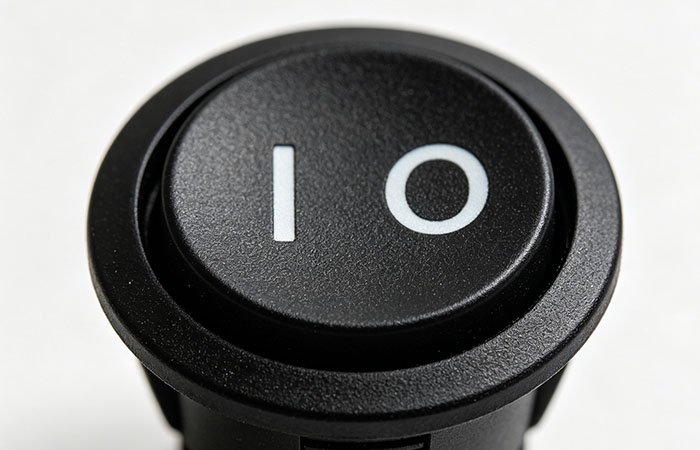
The I, O and II symbols on a switch appear on countless electronic devices. Their…
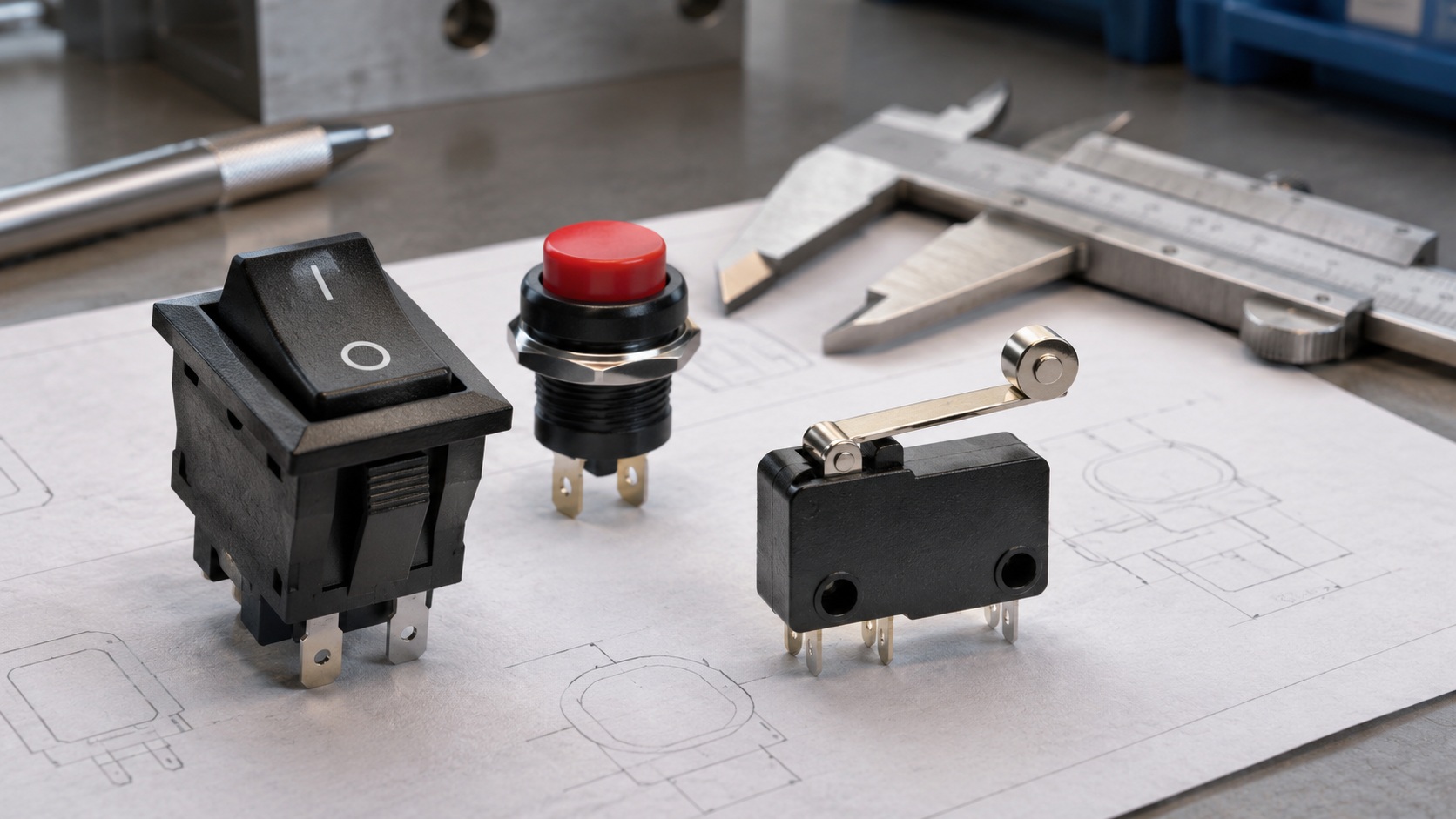
Industrial switches what to define before selecting a part number
Two switches may fit the same panel cut-out and behave differently within a machine. Their external shape does not describe the load they can switch, their function or their installation conditions. Selecting industrial switches starts before part numbers are compared: the application needs to be described using information that can be checked.
A requirements sheet shared by engineering, purchasing and the supplier helps avoid incomplete enquiries and substitutions based solely on dimensions. It also separates essential conditions from preferences. In industrial development, this distinction supports the assessment of standard options or a customised solution while maintaining control of the design.
Define what the switch must do
Start with the required behaviour: whether the action must remain after the operator releases the control or the contact must return to its initial state. State the number of positions needed and the connections associated with each. A symbol on the actuator may help the user, but it does not replace the part's electrical diagram.
Describe who operates the component and under what circumstances. Frequent operation while wearing gloves presents different conditions from an occasional adjustment using a tool. Operating force, travel and accessibility must suit the equipment's use. Recording these needs is preferable to translating them directly into a model without checking the requirements.
Identify the actual electrical load
Operating voltage and current are essential, but they are not sufficient on their own. Distinguish alternating current from direct current and identify the load type. A signal input, a motor and a lamp can place different demands on contacts during opening and closing.
Starting and steady operation
State whether switching involves current peaks and provide the available circuit data. Do not infer compatibility by comparing only two components' rated currents. Declared capabilities relate to particular test conditions and utilisation categories; the technical team must check how they correspond to the application.
For low-current signals, ask whether the contacts suit the level actually being switched. A component intended for higher loads is not automatically the best choice for a small signal. Documentation for the specific part and validation of the complete assembly are more useful than a general rule about power.
Record mounting and connections
Include the cut-out, panel thickness, rear clearance and fixing method. Remember tolerances and the access required to connect or replace the component. A drawing showing only the visible face can conceal interference with a board, support or wiring harness.
Specify whether you require wire terminals, quick-connect connections, soldering or printed circuit board mounting. Include connection orientation and space, along with assembly process constraints. For a replacement, send the full part number and existing drawings: a photograph does not confirm electrical or mechanical equivalence.
Describe the operating environment
Selection must consider temperature, dust, humidity, vibration and possible cleaning products. Describe actual exposure: a control inside an enclosure does not face the same conditions as one on the external surface. A declared protection rating may depend on accessories, seals and how the component is integrated.
Avoid requesting “maximum protection” without defining the risk. It is more useful to explain what may reach the switch, from which direction and during what use. Sealing, resistance and certification claims must be checked for the specific part and planned installation, rather than extended to an entire product family.
Estimate usage without promising service life
Record the expected operating frequency and how the control will be used. These details guide a durability enquiry, but they do not turn catalogue cycles directly into guaranteed years. Behaviour depends on the load, actuation and environment.
If a condition is critical, define how it will be checked during equipment development. Samples may need testing under representative conditions, with agreed acceptance criteria. Switch selection forms part of product validation; a commercial description of robustness cannot replace that process.
Prepare an enquiry purchasing and engineering can share
Bring function, circuit diagram, load, mounting, connections and environment together in one document. Add the drawing revision, expected quantities and identification or customisation needs. Flag open fields and who must approve them, preventing an assumption from becoming a fixed specification.
For example, a manufacturer may have defined the panel cut-out but still need advice on terminals and contact type. Stating this clearly allows the remaining options to be assessed without reopening settled requirements. If the load or geometry changes, update the revision before requesting another assessment.
The sheet should also make clear which documents are supporting information and which define the approved configuration. That distinction helps the supplier ask targeted questions and allows purchasing to compare proposals against the same baseline. It does not remove the need for engineering approval before a part is released for use.
Frequently asked questions
Is fitting the panel enough to replace a switch?
No. Check function, connections, load and environment as well. Matching dimensions do not establish equivalence.
What information is needed to select industrial switches?
Provide the circuit diagram, voltage, current, load type and mounting drawing. Identify conditions that still need confirmation.
Does a sample replace equipment validation?
No. It helps check integration; testing and acceptance criteria must reflect the final application.
Select using verifiable information
M2B Technologies works with switch families and electromechanical components for professional and industrial equipment. Explore its component offering and share your application requirements to discuss a part number or customisation.
An enquiry is more useful when it includes project data and the questions still to be resolved. Choosing a part begins with describing the work it will perform within the equipment.
Related Posts